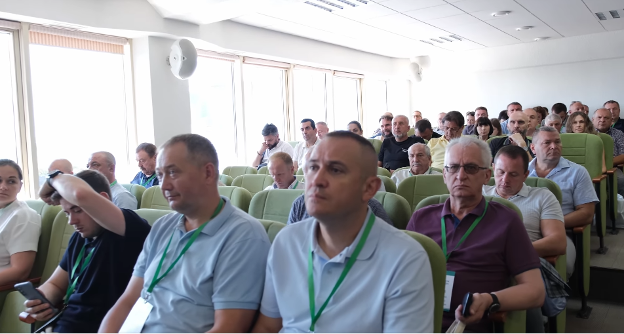
On 15 and 16 August, the All-Ukrainian Agricultural Forum took place in Kropyvnytskyi as part of the All-Ukrainian ‘Made in Ukraine’ project, with the support of the Ministry of Agrarian Policy and Food of Ukraine.
The event brought together Ukraine’s agricultural community to address the most pressing issues facing the agricultural sector under martial law. The programme included presentations of products by local producers, an exhibition of agricultural machinery and equipment, and panel discussions.
The Lviv Agrarian Chamber also participated in this event. As part of the delegation from the Lviv region, LAC representative Davyd Kravchenko took part in the Agriforum.


Taras Vysotskyi, Acting Minister of Agrarian Policy and Food of Ukraine, addressed the participants with a welcoming speech, noting that state authorities are working tirelessly to provide support to farmers, with a particular focus on the ‘Affordable Loans 5-7-9’ programme. Separately, the Acting Minister explained that special programmes are being developed to support agricultural entrepreneurs in frontline areas, as well as those whose businesses remain in temporarily occupied territories. “Draft Law No. 11180-1 has already been registered, which amends the Civil Code of Ukraine regarding lending during martial law. In particular, the legislation provides for a freeze on loan repayments for farmers who were forced to leave their businesses due to the occupation,” noted Taras Vysotskyi.
Andriy Raikovych, Head of the Kirovohrad Regional Military Administration, emphasised that despite all the challenges faced by Ukrainian farmers in the context of full-scale war, they are demonstrating resilience and fortitude. Through their tireless work on their native land, even under the constant threat of enemy shelling, farmers have proven their resilience and determination.


During the two-day forum, participants had the opportunity to view an exhibition of agricultural machinery, equipment and craft products from local producers, and to take part in thematic panel discussions.
In particular, the forum addressed issues of financing and state support for the agricultural sector, current taxation challenges, engagement with foreign markets and European integration, as well as the state of water resources and land reclamation. The forum also discussed the mobilisation of agricultural enterprise staff, and issues relating to energy supply and logistics.