
In February this year, the Lviv Agrarian Chamber (LAC) provided food supplies to 56 institutions in the Lviv region. A total of 49.3 metric tonnes were supplied under the UN World Food Programme’s Institutional Food Programme.
In parallel with the distribution of food, specialists from the Lviv Agrarian Chamber are conducting monitoring visits to assess the storage conditions and use of the donated products.
Today, 18 February, LAC Director Ihor Vuytsyk, Regional Coordinator Anna Kushchak and Monitoring Officer Davyd Kravchenko visited a number of institutions located in the Yavoriv district.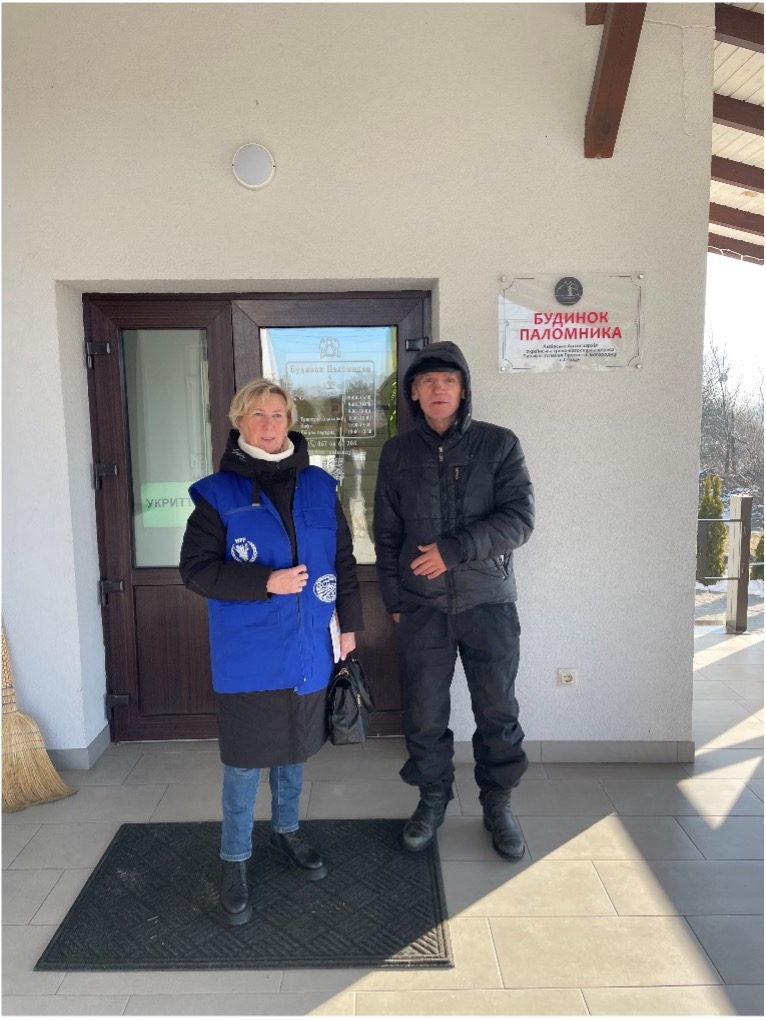

In particular, representatives of the LAC visited the Pilgrim’s House in the village of Stradch, where 25 internally displaced persons have found shelter. During a previous visit by an independent monitoring group, a number of observations were made regarding the storage of food and the presence of posters for the Institutional Food Programme. During the visit, LAP representatives spoke with the rector of the religious church where the shelter operates, Fr. Ivan Koltun, who reported that the recommendations regarding food storage had been implemented. All food is stored on pallets; the storage room is equipped with a thermometer and a hygrometer, and a logbook is kept recording the receipt and use of these products. As for the presence elements, unfortunately, they were lost during the All-Ukrainian Pilgrimage, which took place in September 2024.

Members of the monitoring group had the opportunity to inspect the premises
the warehouse, kitchen and canteen, and to speak with the staff.

“One of the key requirements of the UN WFP Institutional Food Programme is to inform aid recipients about the Programme’s activities, provide opportunities for feedback, and improve programme mechanisms to ensure these people’s needs are met as fully as possible. Therefore, the presence of posters containing such information is very important. With the next food delivery to your facility, information posters will be provided so that they can be displayed in areas frequented by IDPs,” emphasised Ihor Vuytsyk.
The Sudovovyshnianskyi Care Home, a municipal institution of the Luhansk Regional Council, cares for 152 elderly people, including 23 IDPs. Fourteen of them are bedridden and require round-the-clock care. The residents have been displaced from Donetsk, Luhansk and Sloviansk. The care home’s manager, Maria Olekh, explained that the care home receives no humanitarian aid apart from that provided under the Institutional Catering Programme.

“This is a significant help; thanks to these supplies, we have a month’s supply of food throughout the year and are prepared for any force majeure circumstances, which is very important in times of war. Thanks to the budget savings we’ve made possible by the regular food supplies, we’ve bought an electric oven and a dough mixer, and we’re now baking fresh pastries for our residents – pies, buns, and so on. The residents of the care home are very pleased with the current menu, and we very much hope that we will be able to participate in this wonderful Programme again in 2025. On behalf of all our residents, we would like to express our sincere gratitude to the Lviv Agrarian Chamber and the UN World Food Programme for such important and essential assistance,” noted Maria Olekh.

The boarding school’s storekeeper, Maria Yatsyshyn, demonstrated how the food is stored and accounted for, whilst the kitchen staff explained that the food received from the UN World Food Programme is used every day; it is of very good quality and the meals turn out tasty and nutritious.
Another facility in Sudova Vyshnia is a participant in the Institutional Food Programme. This is the Sudova Vyshnia Municipal Hospital. The hospital is small, with just 55 beds. Approximately 10 per cent of patients each month are IDPs. The institution’s chief accountant, Ms Lesya Buchak, explained that last year the hospital renovated the kitchen and storeroom, so food is now stored in proper conditions. Members of the monitoring group inspected these premises and spoke with the staff. Kitchen staff said they were very satisfied with the quality of the food and use it almost every day. Incidentally, today’s menu consisted of pea soup, buckwheat porridge and pancakes.

“Last year, thanks to our collaboration with the Lviv Agrarian Chamber, our hospital saved around 51,000 hryvnias. These funds were used to purchase new kitchenware and a new fridge. We are extremely grateful for such constructive cooperation,” emphasised Lesya Buchak.
The monitoring group also visited the Galchyshak family’s family-type children’s home. Seven years ago, Oleg and Natalia Galchyshak received a sturdy house from the Caritas Charitable Foundation, which they refurbished themselves and took five orphaned children into their care. In total, the family is raising 10 children aged between 7 and 17, including one child with a disability. Two other children are now adults and live separately.


Natalia Halchyshak explained that Caritas helped them with household appliances, but they use their own funds to cover all utility bills, house maintenance, food and all expenses for the children. These are significant sums; in January alone, the family had to pay 10,000 UAH for gas. The family has a 400-square-metre vegetable patch where they grow vegetables for their own needs, but this is not enough for a family of 12.

“When we heard about the UN WFP Institutional Food Programme from other participants in the Programme, at first we didn’t believe that we could receive this assistance too. But we contacted the Lviv Agrarian Chamber and have now received a food parcel for the second time. This is a huge help for us, as food is very expensive at the moment, and we are happy to have this support so we can use our family budget for other essential items. In particular, we are currently installing a new water supply, as the water we currently have in the house is industrial-grade, and we have to bring in water in large containers every day for cooking. “We are very grateful to everyone who, through humanitarian programmes, looks after families like ours,” said Natalia Halchyshak.
The Mostyska City Hospital has been a participant in the Institutional Food Programme for over a year. The hospital serves three local communities and can accommodate 150 patients at a time, 12 per cent of whom are IDPs.
The monitoring group held a meeting with the hospital’s director, Mr Viktor Kopach, who explained that participation in the Institutional Food Programme over the course of the year had enabled savings of almost 300,000 UAH. These funds
were used to purchase essential medicines.

“We currently have no other donors, and the assistance from the Lviv Agrarian Chamber covers 30 per cent of our food requirements. This is a very significant contribution. Thanks to our participation in the Programme, we are able to provide our patients with fresh baked goods – pies and rolls. The hospital has signed an agreement with a private bakery run by the Caritas Charitable Foundation; we provide them with flour, pay for their work, and they bake fresh pastries for us twice a week. Before joining the Programme, we were, of course, unable to do this due to a lack of flour, but now our patients’ menu has become much more varied. By way of comparison: the hospital receives 80 UAH per patient per day for meals. This is far too meagre a sum to provide a balanced diet, so the assistance from the Lviv Agrarian Chamber is very much appreciated,” noted Viktor Kopach.

Following the monitoring visits, representatives of the LAC noted that in virtually all the institutions visited, the recording and storage of foodstuffs met the requirements. However, there were no UNWFP posters. Ihor Vuytsyk drew the attention of the heads of these institutions to this fact, explaining that such signage is mandatory throughout the duration of the Institutional Food Programme, and emphasised that during the next food deliveries, each institution would receive new posters, which must be displayed in areas frequented by those receiving assistance.
Source: Lviv Agrarian Chamber